Detailed Description
CoAP 101
CoAP was originally specified in RFC 7252 and could only be used in combination with UDP and DTLS as transport protocols. RFC 8223 modified the CoAP format for sending CoAP messages over TCP, TLS, and WebSockets (including WebSockets over TLS). There is also an Internet Draft for CoAP over GATT (BLE).
Each of these standards leverage different messaging models, i.e., what timeouts to apply, how reliable transmission is implemented, and what messages are allowed to be sent in response to a certain message type. A custom CoAP PDU header (i.e., another PDU format) has been specified for CoAP over reliable transports. For instance, CoAP over UDP and over DTLS share the same PDU format; so do CoAP over TCP and TLS. The set of protocol characteristics that vary depending on the transport forms a specific version of CoAP, which is called a CoAP combination in unicoap. For instance, CoAP over UDP is CoAP combination, so is CoAP over DTLS.
Layered Design
The design of unicoap involves three distinct layers that reflect the layered approach of CoAP, as shown in the figure below. Conceptually, newly received message traverse these layers up to the application, and data sent by the application travels in the opposite direction. Located beneath the application, the exchange layer embodies the REST model of CoAP. It is responsible for handling advanced CoAP features operating above the request-response exchanges, such as resource observation and block-wise transfer. This layer is shared between CoAP combinations, i.e., the REST semantics remain the same, regardless of the messaging model and transport beneath. Since messaging differs between CoAP combinations, a modular design to ease the addition of new CoAP combinations was necessary: The layer dedicated to messaging covers framing and can accommodate a custom reliability mechanism, such as the one specified in RFC 7252 (using the four tempers CON, NON, ACK, RST). Serializing messages and parsing PDUs received from the network are also handled by the messaging layer. The transport layer at the bottom manages different transport protocols. Here, unicoap coordinates with the operating system networking interface.
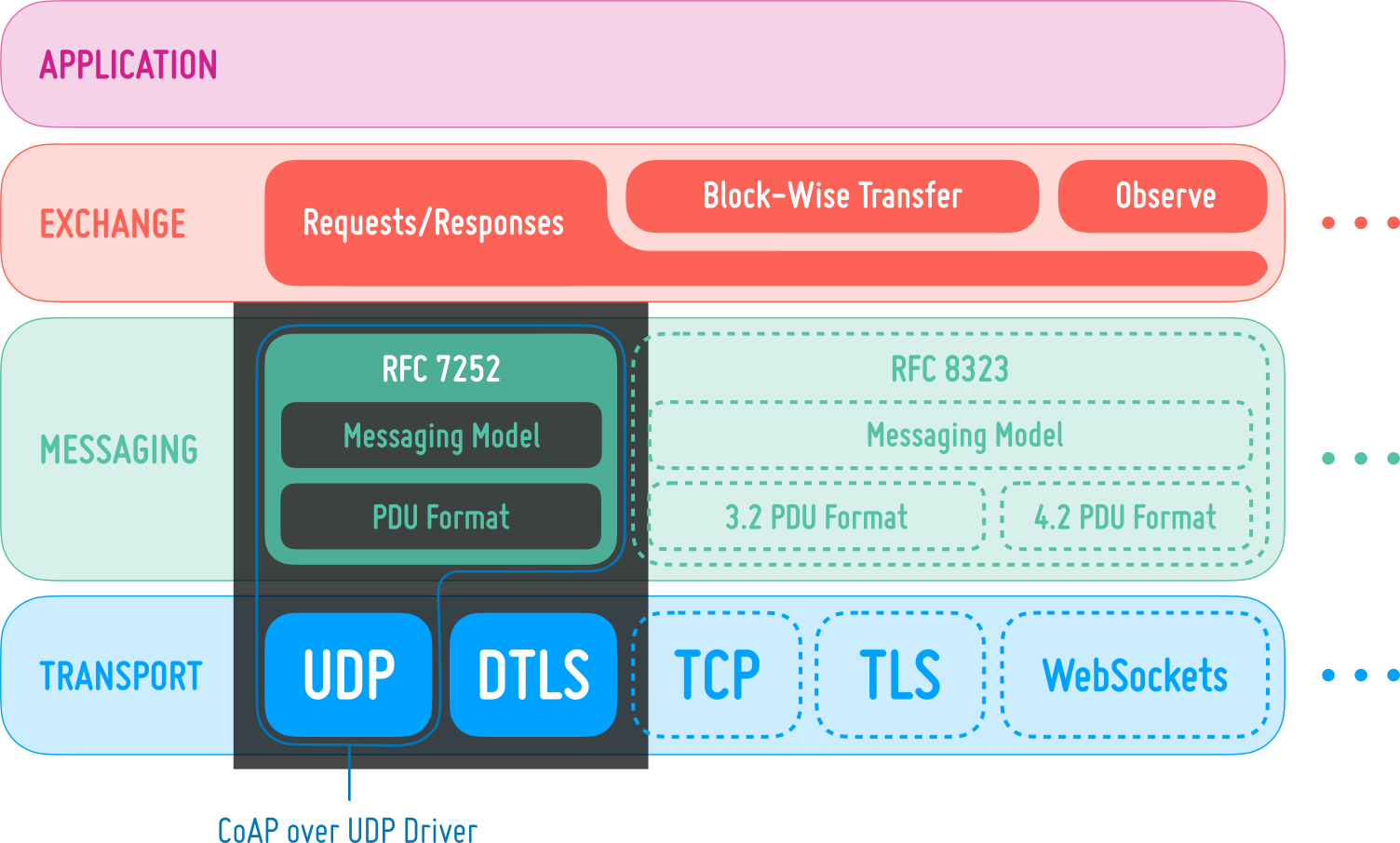
Overview of CoAP Combinations
To better illustrate what parts of the CoAP stack differ, have a look at the following graph, where each node represents a version of a certain layer. Each leaf node stands for a different CoAP combination ("CoAP over ...") specification.
CoAP over UDP and CoAP over DTLS (RFC 7252)
CoAP over UDP and DTLS works with messages of different types. A message can be confirmable (a CON message), non-confirmable (NON), an acknowledgment message (ACK), or a reset message (RST). Confirmable messages elicit an acknowledgement message to be sent by the peer. Hence, RFC 7252 provides optional reliability (i.e., retransmission using an exponential back-of mechanism) using confirmable and acknowledgement messages.
- See also
- RFC 7252
CoAP over TCP, CoAP over TLS, and CoAP over WebSockets (RFC 8323)
RFC 8323 eliminates the need for reliability to be implemented on the application layer, as the underlying transport protocol already provides reliability. While message processing looks the same for both CoAP over TCP/TLS (RFC 8323, Section 3) and CoAP over WebSockets (RFC 8323, Section 4), the PDU format employed does vary a little between them.
- See also
- RFC 8323
CoAP over GATT over Bluetooth Low Energy (BLE) (IETF Draft)
The CoAP over GATT (BLE) messaging layer works entirely different from previously specified Constrained Application Protocol variants. Hence, the PDU format is also custom and optimized to take as little space as possible to reduce airtime.
Drivers
To integrate new CoAP combinations, functionality for messaging and transport layer must be added. The unicoap design refers to these integrations collectively as a driver that represents a CoAP combination, such as CoAP over DTLS. Each driver is a RIOT module you can import. For instance, to use the CoAP over UDP driver, you import the unicoap_driver_udp by adding it to the USEMODULE Makefile variable: USEMODULE += unicoap_driver_udp.
Drivers themselves can in turn consist of a shared module for messaging and a specific transport support module. For example, the CoAP over DTLS driver encompasses a transport module for DTLS networking; and depends on the common RFC 7252 messaging module also employed by the CoAP over UDP driver. You can see this relationship in Makefile.dep in the unicoap source directory: The common messaging module is a shared dependency of both the CoAP over UDP Driver and CoAP over DTLS Driver driver module. We encourage you to follow the same approach for CoAP combinations that share a common messaging model, such as CoAP over TCP, TLS, and WebSockets when implementing these.
On a high level, each driver interacts with the upper layers on these three occasions:
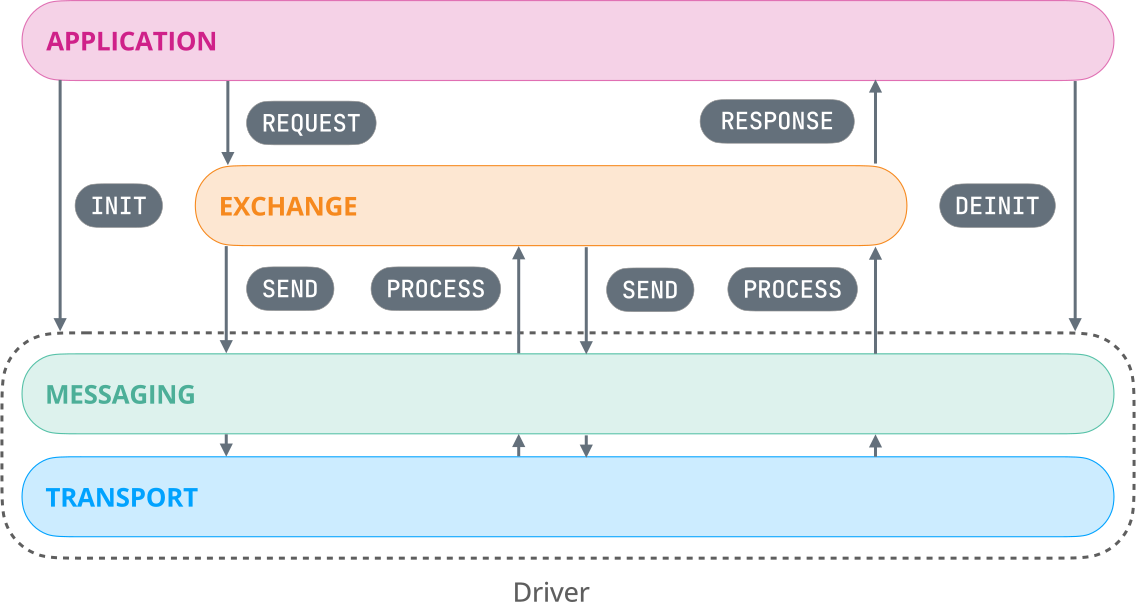
- Initialization and deinitialization: Drivers must provide an initialization and teardown. These may be used for setup work in the transport and messaging layer such as for creating sockets or establishing connections to peripherals, alongside allocating objects required for messaging.
- Sending side / Outbound: A driver must expose a standardized API for sending from the messaging layer. The exchange layer will call into this functionality, prompting the driver to perform any due work in the messaging layer like attempting to retransmit the message. Apart from the message, as well as the remote and local endpoint, this function accepts flags that customize transmission behavior. The RFC 7252 message type is abstracted into a reliability flag the messaging layer in the CoAP over UDP and DTLS drivers interpret as an instruction to send a confirmable message. When finished, the messaging layer serializes the message and forwards it to the transport implementation.
- Receiving side / Inbound: Upon receipt of a new message, each driver will need to invoke an exchange-layer processing function.
- Ping: Due to the variability in ping mechanisms (empty
CONin CoAP over UDP and7.03message in CoAP over reliable transports), each driver can implement a ping function. unicoap bundles these APIs and provides a single, generic ping function that multiplexes between the driver implementations.
Communication Between Layers
The following figure illustrates communication between layers in a block-wise transfer, where a client request from the application may result in multiple unicoap_messaging_send and unicoap_exchange_process calls between the exchange and messaging layer:
The next schematic depicts how these APIs are implemented, based on the CoAP over UDP and CoAP over DTLS drivers that share the RFC 7252 messaging implementation:
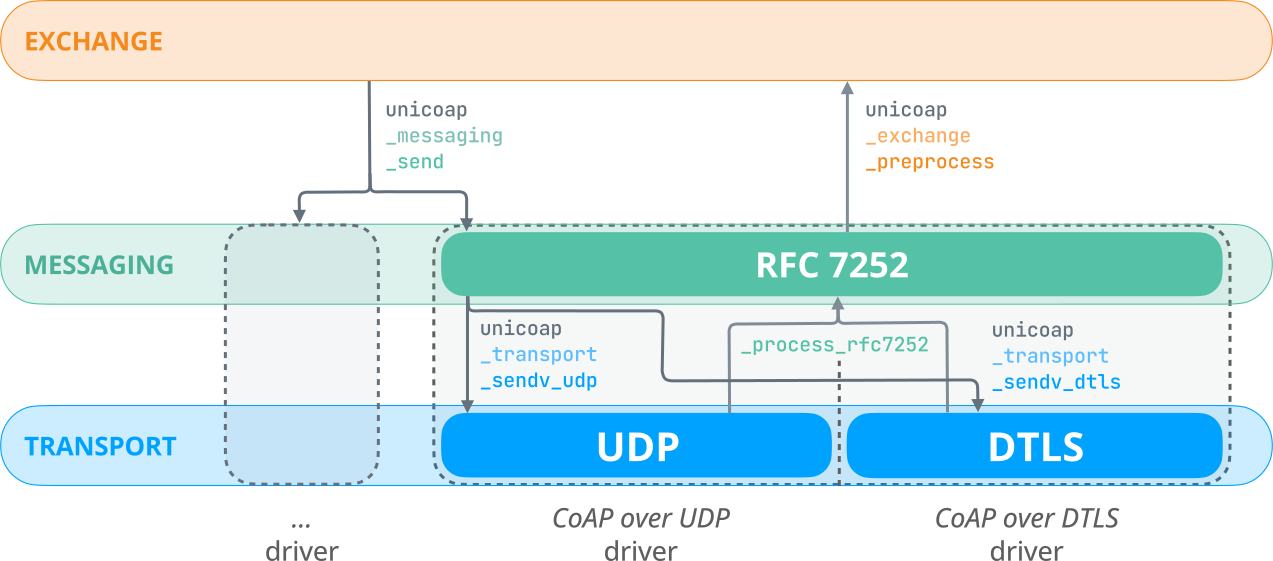
Both the CoAP over UDP and CoAP over DTLS driver support sending vectored data, hence the sendv suffixes in the function names depicted in the figure above.
To manage state, the exchange and messaging layer(s) exchange notifications composed of a notification type and an opaque state object pointer that may point to the layer-internal state object representation. Notifications (unicoap_layer_notification_t) are sent using unicoap_messaging_notify and unicoap_exchange_notify. The notification system serves two purposes.
State Lifecycle Notifications
First, it informs the respective other layer about the allocation and release of owned state objects, such that a layer A can decide whether it should also release state when layer B has just released a state object associated with a state object on layer A. Each layer may keep references to state objects allocated in the respective other layer — this ought to be an opaque reference (void*) in most instances. Generally, layers are not expected to know the memory layout and interface needed to control state objects of other layers. Layer A gets to know of opaque references to state owned by B through an allocation notification from B. For example, the exchange layer stores state objects called memos that track an exchange which may, in turn, encompass multiple transmissions on the messaging layer in the case of a block-wise transfer. Once the messaging layer has sent a state release notification to the exchange layer, the exchange layer may also release its memo if the block-wise transfer is done or keeps the memo otherwise. Each time a new CoAP message is sent, the messaging layer informs the exchange layer of any new state object allocation such that the current messaging state reference in the memo can be set.
Error Notifications
Second, notifications allows one layer to propagate errors that occurred asynchronously. This case is called asynchronous failure as synchronous failures, i.e., those originating from a function call from the other layer, must be propagated by returning an error instead. This is usually done by returning a negative error number, but you should check each function's documentation. For example, one layer may have set a timeout that once expired leads to an asynchronous error condition that must be propagated to the other layer so it can handle the error, i.e., by retrying or by releasing a state object it owns if it cannot recover. Triggers for these asynchronous scenarios may be the reception of an inbound PDU on the messaging layer, or the invocation of an API above the exchange layer. Crucially, should an error leading to state release occur on one layer, it may decide between a regular state release notification to the other or an error notification, depending on the implications. For example, if the failure condition is the user calling cancel on a pending request, the exchange layer may determine it is better to release state in an orderly fashion, i.e., to communicate a regular state release notification to the messaging layer instead of an async failure notification as the messaging layer may tear down transport connections in the latter instance. In general, you should question if an error on layer A is really relevant to layer B or if communicating the mere consequence of the error on A (regular state release notification instead of async failure notification) suffices to cause an associated state object on B to be discarded.
Adding a New Driver
In the unicoap codebase you will encounter several marks (MARK: ...) that help with extending the suite.
- MARK: unicoap_driver_extension_point: Every region of code that would need to be extended to support a new transport protocol or driver is annotated with this mark.
Topics | |
| Private API | |
Implementation details of unicoap | |