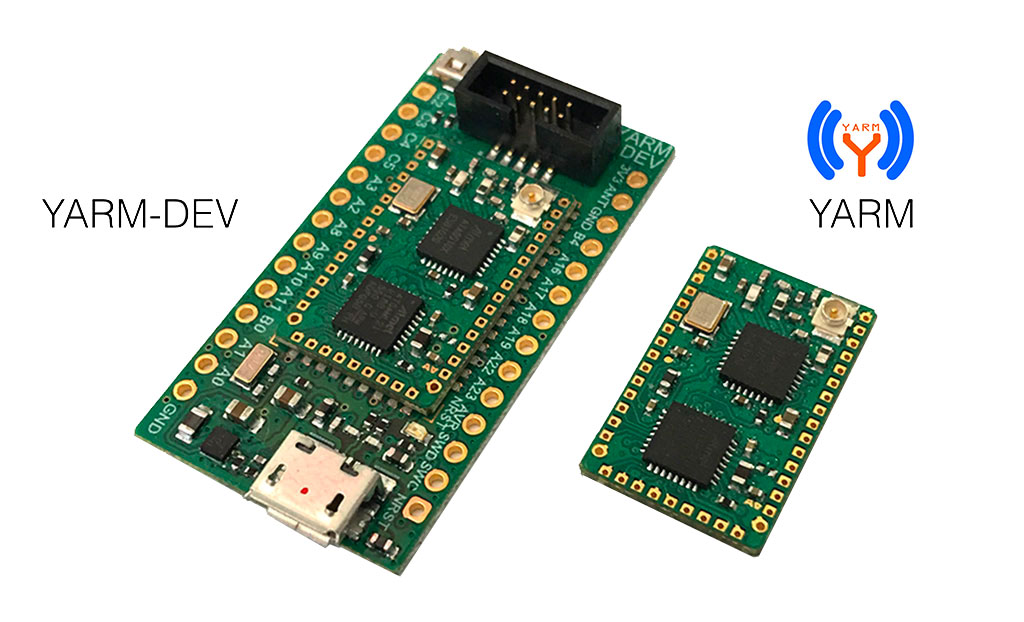
Support for the Acmesystems YARM board. More...
Detailed Description
Support for the Acmesystems YARM board.
Overview
Yarm is a smart and cost effective solution for system integrators to build their own RF applications at 868 MHz avoiding all the hardware design costs requested to start a new custom RF project.
Yarm integrates:
- a Microchip SAML21 low power MCU
- a Microchip ATA8510 radio module
See Acmesystems product page for more information.
In the provided configuration, stdio is available via USB. The board can be configured to provide it on the exposed UART instead, by defining
Depending on the connection to your PC, you will probably also need to set PORT_LINUX to a different value (default is /dev/ttyACM0), for instance
Hardware
MCU
| MCU | ATSAML21J18B |
|---|---|
| Family | ARM Cortex-M0+ |
| Vendor | Microchip |
| RAM | 32Kb |
| Flash | 256Kb |
| Frequency | up to 48MHz |
| FPU | no |
| Timers | 8 (16-bit) |
| ADCs | 1x 12-bit (20 channels) |
| UARTs | x 6 (shared with SPI and I2C) |
| SPIs | max 6 (see UART) |
| I2Cs | max 6 (see UART) |
| Vcc | 1.8V - 3.6V |
| Datasheet | Datasheet |
RADIO
| Transceiver | ATA8510 |
|---|---|
| Vendor | Microchip |
| Sensitivity | -123dBm |
| Output power | -12dBm to +14.5dBm programmable in 0.4-dB steps ] |
| Datasheet | Datasheet |
NOTE: not all MCU interfaces are available on YARM; see the pinout to know more.
Implementation Status
| Device | ID | Supported | Comments |
|---|---|---|---|
| MCU | saml21 | partly | PLL clock not implemented |
| Low-level driver | GPIO | yes | |
| PWM | yes | ||
| UART | yes | ||
| I2C | yes | ||
| SPI | yes | ||
| USB | yes | ||
| RTT | yes | ||
| RTC | yes | ||
| RNG | yes | ||
| Timer | yes | ||
| ADC | yes |
Flashing the device
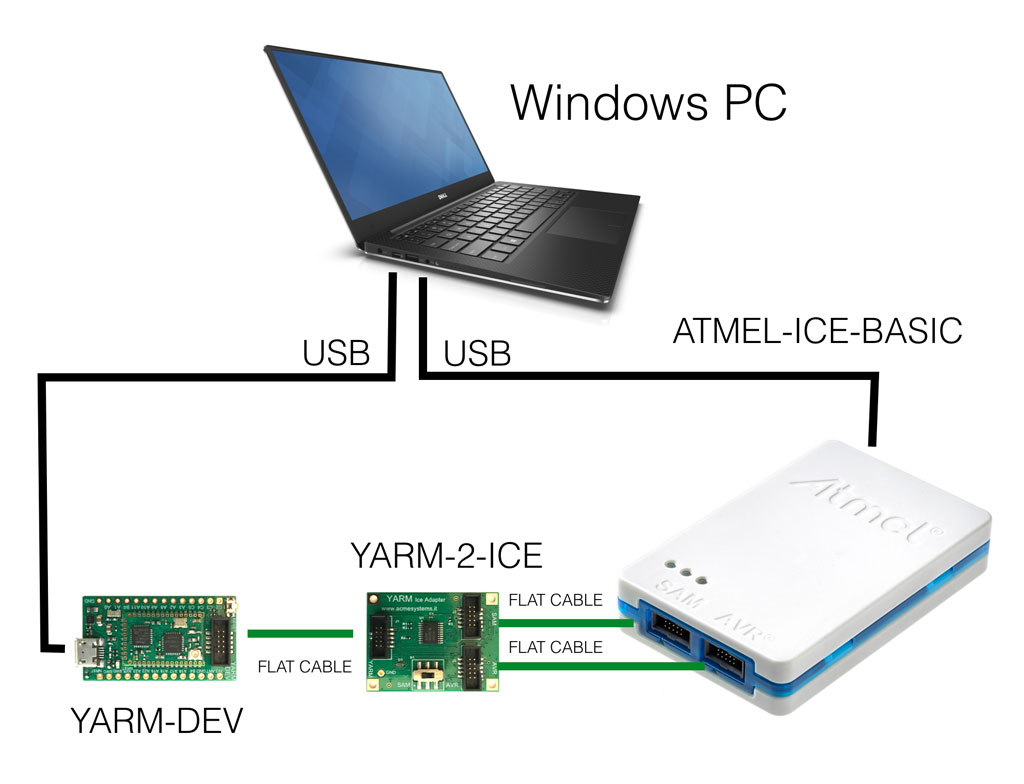
Both the MCU and the radio module are flashed using Atmel ICE, with the help of a small adapter. The software used is edbg, bundled with RIOT.
On Linux you might have to add a udev rule for Atmel ICE, like
Files | |
| file | board.h |
| Support for the Acmesystems YARM board. | |
| file | periph_conf.h |
| Peripheral MCU configuration for the Acmesystems YARM board. | |